
Knowledge Graph Optimization: Google Entity SEO vs. Internal Graphs
Search 'knowledge graph optimization' in 2026 and you get a wall of enterprise data-engineering posts about Neo4j and ArangoDB. None of them explain how Google's Knowledge Graph actually decides whether your business exists as an entity. That gap costs real money. This is the canonical answer for SEOs and growth operators who need both definitions kept separate. Our AI SEO agency work is built on exactly this distinction. It changes every tactic on the list.
What are the two types of knowledge graph optimization?
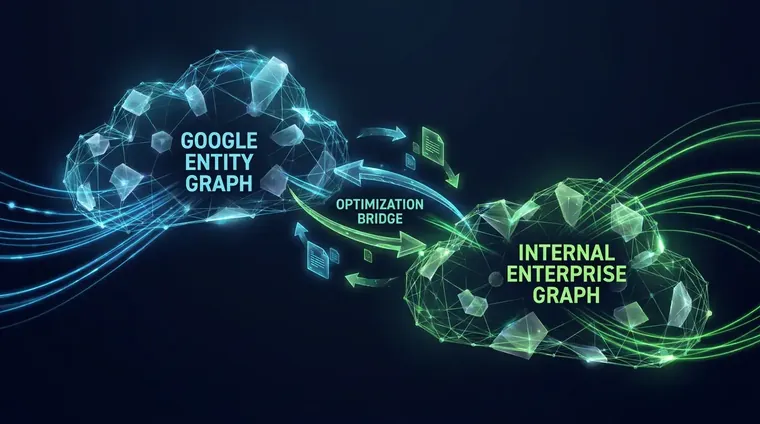
Knowledge graph optimization splits into two distinct goals: optimizing an internal enterprise graph database, and optimizing for inclusion and accuracy inside Google's public Knowledge Graph.
Most content treats knowledge graph optimization as one discipline. It isn't. There's a hard fork at the start.
Type 1. Internal KGO is what Databricks, Neo4j, and the data-engineering crowd mean: improving the structure, density, and query performance of a proprietary graph database inside your infrastructure. Tools like Apache NiFi, Talend, and spaCy handle ingestion and entity extraction. Gephi or Graphistry handle visualization. The success metric is query latency and inference accuracy.
Type 2. Google KGO is what SEOs mean: getting your brand, product, or person treated as a named entity inside Google's public Knowledge Graph so it surfaces in Knowledge Panels, AI Overviews, and entity-aware search features. The inputs are Schema.org markup, Wikidata entries, Wikipedia mentions, Crunchbase profiles, and structured corroboration from authoritative third-party sources.
Conflating these two is why most knowledge graph optimization programs underdeliver on at least one front. Enterprise teams tune their internal graph while their Google entity record stays thin, ambiguous, and easily confused with a competitor. SEO teams stuff schema while ignoring that Google's graph crawler weights co-citation and third-party corroboration far more than on-page markup alone.
What signals actually feed Google's Knowledge Graph?
Google's Knowledge Graph is fed by structured data markup, Wikidata/Wikipedia corroboration, co-citation patterns, and entity co-occurrence across authoritative third-party sources. Not on-page content alone.
- Schema.org structured data Organization, Person, LocalBusiness, and Product schema give Google a machine-readable entity definition. Google Search Central documents which schema types trigger rich result and Knowledge Panel eligibility.
- Wikidata + Wikipedia corroboration A Wikidata QID is the closest thing to a permanent entity ID in Google's graph. A Wikipedia article citing the same entity name, founding date, and industry signals to Google the entity record is trustworthy and stable.
- Co-citation and entity co-occurrence When authoritative publications mention your brand alongside known entities. A named founder, a city, an industry category. Google uses that co-occurrence to strengthen disambiguation. One industry journalist quoting your CEO alongside two known competitors does more KGO work than ten schema deployments.
- Crunchbase, LinkedIn, and niche directories Third-party data providers feed Google's entity reconciliation pipeline. A consistent NAP (name, address, phone) across Crunchbase, LinkedIn, and vertical directories reduces the chance of entity disambiguation errors. Where Google's graph merges or splits your entity incorrectly.
- Internal link architecture + anchor text Google reads your own site as a corroboration source too. Our SEO website design work hardwires entity-consistent anchor text into the URL structure before the first page is published. Not bolted on after launch.
AI search isn't theoretical. 417 Copilot citations and 16.74% share of authority on Safeguard Impact, measured in Microsoft Clarity, prove the AI-Overview extraction patterns we write for actually work. That number exists because we optimize entity structure, answer extraction, and schema together. Not as three separate workstreams.

How do you measure knowledge graph optimization success?
Measure KGO with Knowledge Panel trigger rate, AI Overview inclusion frequency, entity coverage rate across authoritative third-party sources, and structured-data error count in Search Console.
Neither of the top-ranking posts on this topic names a single KPI. That's a tell.
For Google KGO, the metrics that matter are: Knowledge Panel trigger rate (does a panel fire for your brand name?), AI Overview inclusion (is your content being pulled as a cited source?), entity coverage rate (how many authoritative third-party sources carry a consistent entity record?), and structured-data error count in Google Search Central's Rich Results Test.
For internal KGO, the metrics are different: graph density (ratio of edges to nodes), query latency (P95 response time under load), disambiguation accuracy (percentage of entity extractions that resolve to the correct canonical node), and relationship drift rate (how often stale edges produce incorrect inferences).
Track these separately. A KGO dashboard that mixes graph query latency with Knowledge Panel impressions is using one speedometer for two different machines. Run an SEO audit first. Establish your entity baseline before you touch a single schema tag or graph config. Guessing at the gap costs more time and more money than measuring it.
How do you run a Google Knowledge Graph optimization sprint?
A Google KGO sprint runs in four steps: entity audit, schema deployment, third-party corroboration, and citation monitoring. In that order.
- 1Audit your entity record firstSearch '[Brand] site:en.wikipedia.org', '[Brand] site:wikidata.org', and '[Brand]' on Google with a fresh session. Screenshot what fires (or doesn't). This is your baseline. If no Knowledge Panel fires and no Wikidata QID exists, you're starting from zero. And that's fine, but name it.
- 2Deploy and validate schemaImplement Organization or Person schema on every canonical page using Schema.org specs. Validate with Google's Rich Results Test. Fix every error and warning. Google treats schema errors as low-trust signals, and a broken schema is worse than no schema on some entity types.
- 3Build third-party corroborationCreate or claim your Wikidata entry. Ensure Crunchbase, LinkedIn, and any niche directory carry the exact same entity name, founding year, and category. Pitch one industry publication for a brand mention that names your category. Co-citation from a trusted source accelerates disambiguation faster than any on-page change.
- 4Monitor Knowledge Panel and AI citationCheck Knowledge Panel status monthly. Track AI Overview inclusion using Microsoft Clarity, Search Console, and manual searches. Log your entity coverage rate across third-party sources quarterly. When the panel fires or an AI citation appears, screenshot it. These are your receipts.
Why does entity disambiguation failure hurt rankings?
Entity disambiguation errors cause Google to merge your brand with a competitor or split your entity into two thin records, diluting Knowledge Panel authority and lowering AI Overview citation probability.
Disambiguation failure is the most under-documented failure mode in knowledge graph optimization. It happens when Google's graph can't confidently resolve 'Acme Corp' to a single canonical entity. Usually because the name is generic, the schema is inconsistent, or third-party sources disagree on basic attributes like founding date or headquarters city.
The result isn't a ranking penalty. It's quieter and harder to spot. Your brand gets merged into a parent entity, or split into two thin records, or treated as a local branch of a national chain it has nothing to do with. Knowledge Panels don't fire. AI Overviews cite the wrong source.
One practitioner on a Hacker News thread put it plainly: 'Google's search algo is still pretty dumb' (source, @letterlib). When the entity signal is ambiguous, the algorithm defaults to the entity it already knows. The fix is corroboration density, not schema cleverness. More authoritative sources saying the same thing about your entity is the only reliable disambiguation signal.
This is also why the Search Quality Rater Guidelines spend significant space on E-E-A-T for entities, not just pages. Raters evaluate whether an entity has a clear, corroborated identity. That evaluation feeds the training data that shapes how the graph treats your brand.

Internal KGO vs. Google KGO: which tactics apply where?
Internal KGO uses graph database tooling and NLP pipelines; Google KGO uses schema markup, Wikidata, and third-party co-citation. The playbooks share no tools and no metrics.
| Feature | Internal Knowledge Graph Optimization | Google Knowledge Graph Optimization |
|---|---|---|
| Primary tools | Neo4j, ArangoDB, Amazon Neptune | Schema.org markup, Wikidata, Google Search Console |
| Entity extraction | spaCy, BERT, OpenAI GPT models | Structured data + third-party co-citation |
| Success metric | Query latency, disambiguation accuracy | Knowledge Panel trigger rate, AI Overview citations |
| Failure mode | Relationship drift, stale node data | Entity disambiguation errors, thin corroboration |
| Primary audience | Data engineers, ML teams | SEOs, brand managers, growth operators |
Hot take: schema markup is necessary but nearly irrelevant on its own. We've seen sites with flawless Organization schema and zero Knowledge Panels. One Wikidata entry with a typo and no external citations killed them. Meanwhile, brands with mediocre schema but strong Wikipedia mentions and Crunchbase profiles got panels within weeks. Corroboration is what moves the needle. Schema is just the label on the jar.
Frequently Asked Questions
What is knowledge graph optimization for Google specifically?
Knowledge graph optimization for Google means improving how Google's public Knowledge Graph represents your brand as a named entity. This involves deploying Schema.org structured data, creating or claiming a Wikidata entry, building third-party co-citation from authoritative sources, and ensuring consistent entity attributes (name, founding date, category) across directories like Crunchbase and LinkedIn. Success is measured by Knowledge Panel trigger rate and AI Overview citation frequency. Not by graph database performance metrics.
How long does it take to get a Google Knowledge Panel in 2026?
Most brands with zero prior entity presence see their first Knowledge Panel fire within 8–16 weeks of a structured KGO sprint. Assuming a Wikidata QID is created, Organization schema is deployed and error-free, and at least two authoritative third-party sources carry a consistent entity record. Brands with existing entity signals (Wikipedia article, strong Crunchbase profile) can see panels in 3–6 weeks. There's no guaranteed timeline; Google's entity reconciliation pipeline runs on its own schedule.
Does Schema.org markup alone create an entity in Google's Knowledge Graph?
No. Schema markup helps Google read your entity definition, but it doesn't create the entity in Google's Knowledge Graph by itself. Google requires corroboration from authoritative third-party sources. Wikidata, Wikipedia, industry publications, and niche directories. Before treating a brand as a stable, disambiguated entity. Schema with no external corroboration is a claim without a witness, and Google's graph does not promote uncorroborated claims.
What are the most common knowledge graph optimization failure modes for SEO?
The three most common Google KGO failures are: entity disambiguation errors (Google merges your brand with a competitor or splits it into two thin records due to inconsistent entity attributes), stale Wikidata entries (an outdated QID with a wrong category or headquarters city actively confuses Google's reconciliation pipeline), and schema errors left unfixed (broken Organization or LocalBusiness schema signals low trust and can suppress Knowledge Panel eligibility). Run a Rich Results Test and a Wikidata consistency check before anything else.
How does knowledge graph optimization improve AI citation rates?
AI systems like Google's AI Overviews and Microsoft Copilot extract answers from sources they treat as authoritative entities. Not just pages. A brand that has a clean Knowledge Graph presence (Wikidata QID, consistent schema, strong co-citation) is more likely to be recognized as a trustworthy entity whose content gets lifted into AI-generated answers. Receipts Group measured 417 Copilot citations and 16.74% share of authority on Safeguard Impact via Microsoft Clarity. Direct evidence that entity optimization drives AI citation, not just traditional blue-link rankings.
Related reading
Ready to optimize your entity presence?
We run entity audits, schema deployments, and AI citation monitoring inside our AI SEO agency program. And we bring the receipts. Every Knowledge Panel status, every AI Overview citation, every schema validation lives in a dashboard you can verify on your own. Want to see where your entity record stands before committing to a sprint? Start with our SEO audit. One pass covers entity baseline, schema health, and corroboration gaps.